

← Back to CPA Leadership Journal
Best Practices in Revenue Growth, Part I: Goal Setting and Strategy
What will it take for your firm to sustain revenue growth? Before you start spending time and money on marketing and sales activities, establish a framework with strategy.
How to achieve a growth goal
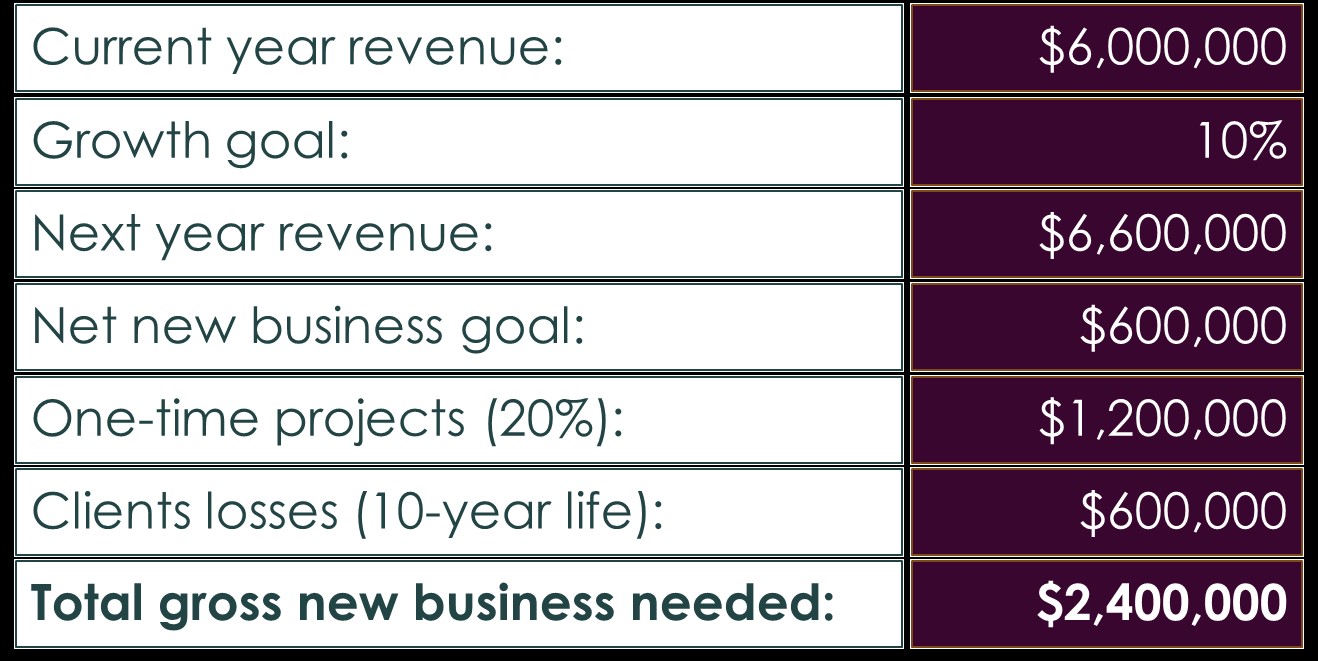
First, set realistic growth goals. Plan not only what will be your firm’s net services goal, but how you will achieve it. For example, if your current year revenue is $6 million, a 10% growth goal for the coming year would be $6.6 million, or an increase of $600k. But leaders who fail to plan for the non-annuity projects they must replace as well as the average useful lifespan of client relationships may be less than satisfied with their results. Let’s look at how these two factors affect a firm’s ability to meet its net growth goal.
One-time projects
Non-annuity projects may account for as much as 5% to 30% of your firm’s revenue. Projects such as business valuations, estate planning, and succession planning create a one-time, discrete project. Consequently, your firm needs to plan for how to replace this type of income each year.
Client loss
Many of the causes of client losses are unpredictable and outside the firm’s control. Clients sell their businesses. They merge, become less complex, or go out of business. Sometimes they go public. Yes, a small minority of clients leave because of service or relationship issues, but the greater risk to meeting your growth goal is the natural cycle of business. Your client relationships have an “average useful life.”
If clients stay with your firm an average of 10 years, your firm will lose 10% of total revenues each year. If clients stay with your firm for 15 years, your firm will lose 6.7% each year, and if they stay for an average of 20 years, your firm loses 5% of clients each year. To maintain your firm’s income and reach new growth goals, natural client loss cannot be ignored. Because client losses are not always predictable, we suggest you plan to do enough work each year to replace the average losses based on the average useful life of your client base. Doing so enables your firm to absorb the losses when they happen and still have a positive growth curve over the long run.
Setting a growth goal
To successfully grow your firm, calculate how much gross new business you must generate to meet your net revenue goal. Using the previous example of the $6 million firm looking to grow by 10%--with 20% of its annual revenues from one-time projects and clients with an average useful life of 10 years--this firm must achieve the following gross new revenue:
Once you calculate the gross new business needed, consider where there is opportunity to generate it. There are four ways to grow top line revenues:
- Increase your fees
- Replace the volume of non-annuity projects you did last year
- Deliver additional services to existing clients
- Add new clients
Once you determine how much of the gross new business needed will come from each of the four areas above (the total revenue from the four areas MUST equal your gross need in order to make your net goal) you are ready to make decisions about what sales and marketing activities to implement.
Determining the right activities
Your firm should examine how you want to approach growth each year. A useful tool for providing insight is a matrix of the four basic growth strategy alternatives, which are determined by services and target markets.
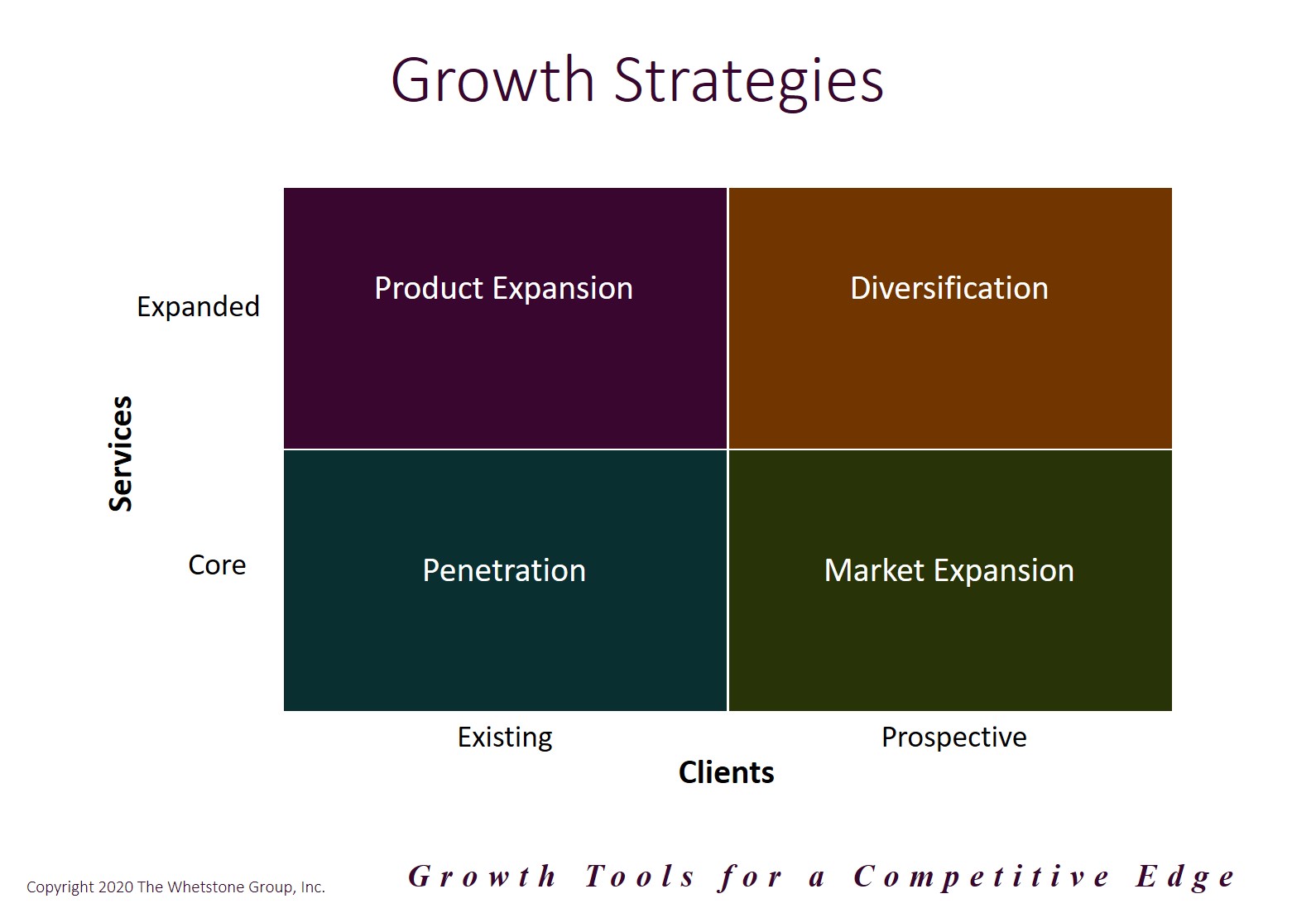
The four strategies are:
Penetration: Market core services to existing clients.
Product Expansion: Market expanded services to existing clients.
Market Expansion: Market core services to potential clients.
Diversification: Market expanded services to potential clients.
Core services
Core services are the services you do a lot of, for a lot of people, which are already associated with your brand such as audits, tax, and accounting. Start by evaluating whether you are serving all your existing clients with your core services to the maximum extent possible. If not, you can pursue growth within your existing client base and existing services. Existing staff is in a good position to facilitate this type of growth.
Expanded services
Next, look at your expanded services — the services you do for some clients, but not all, such as estate planning, business valuations, technology consulting, or specialty tax services. Evaluate your existing clients’ needs and determine how their needs intersect with your expanded services. Senior staff and managers can contribute to marketing activities in this strategy by helping identify opportunities.
Finding ways to help existing clients is the least costly, most dependable growth strategy. Study these approaches first. As you consider the other alternatives, you can expect your activities to take longer to generate results and be more expensive yet less predictable.
Market expansion
After analyzing opportunities for growth with existing clients, consider how you can reach new clients with the core services you have already mastered. Market expansion growth is best handled by managers and partners.
Diversification
Finally, determine how you can offer new services to new clients. Diversifying your offerings is a growth opportunity, but it is also a long-term, higher risk venture requiring considerable time and money. Firm leadership is in the best position to pursue this type of new endeavor.
Allocate resources toward each of the four approaches in proportion with your firm’s assessment of growth opportunities. Establish where the biggest opportunity for growth is — inside the client base or outside — and what your other partners and managers are willing and skilled enough to do.
Questions to ask during the planning process
- How penetrated your firm is within the client base?
- Do your employees know enough about the expanded services to identify an existing client need?
- How much revenue do you need to get from current clients, and how much from new clients, to meet your growth goal?
- How many new clients does your firm need to acquire to meet growth goals?
Answering questions such as these helps you determine the amount of time to assign to each strategy.
After evaluating the opportunities, you can go back and adjust for how much of your growth goal needs to come from price increases, new services sold to current clients, and new clients. You may determine that you need to update your growth goal if you aren’t convinced you can generate the gross new business needed to make it happen.
Thinking about growth from this strategic perspective enables your growth team to decide which marketing and sales activities to implement. In our next article we’ll tell you how to maximize the effectiveness of your activities to create the best chance of meeting your goal.
Larry Bildstein is the CEO of The Whetstone Group, Inc., helping CPA firms and professional service firms nationwide find growth and hone their competitive edge.
Read the corresponding article: Best Practices in Revenue Growth, Part 2: Maximize Effectiveness of Your Business Development Activities