
Best Practices in Revenue Growth, Part 2: Maximize the Effectiveness of Your Business Development Activities
In our previous article we summarized a methodology for setting a growth goal and provided the model for evaluating the source of the revenue based on the strategic growth alternatives available to your firm. (If you need a review, you can access that previous article here.)
Once your leaders agree on the opportunities associated with each of the growth strategies—penetration, service expansion, market expansion and diversification—you are ready to define the activities you want to engage in. As you consider each strategy, and the tactics that will help accomplish it, you’ll see that these activities and behaviors are different depending on the strategy.
For example, the strategy of market expansion is about attracting new clients based on your core services and established brand. One of the tactics to accomplish this could be networking with referral sources (centers of influence) who can introduce you to qualified prospects. But interacting with possible referral sources periodically doesn’t lead to new business in and of itself, so it’s important to consider the process of building relationships with possible referral sources and to systematize the approach.
So how do you do that? If you have partners in your firm who seem to be excellent at networking and are constantly getting referrals, it may seem so natural and easy that it doesn’t appear to be work. But what you may not see, and what those people who are good at developing relationships may not even be able to describe, is the process of building those relationships. Upon closer examination, we have seen there are patterns that good networkers follow.
Take a before-during-after approach
The following outline breaks down a brief series of activities that promote success in building relationships with referral sources. As you consider your own actions it’s helpful to engage in what we call a “before-during-after” approach. Think about your objective and what you have to do before the activity to plan and prepare. Then, during the activity, while you are engaged in “doing”, make a list of what should be your behaviors. And after the execution, think about what follow up you may need to engage in to achieve your objective.
Example: Networking with referral sources
Before (What do I have to do before I communicate with referral sources?)
- Identify your ideal target client
- Identify referral sources that might be connected to your ideal target clients
- Plan your communication (what, when, how)
During (How do I make the most of the interactions with referral sources?)
- Meet face-to-face (either in person on using technology like Zoom)
- Explore the benefits of referring to each other
- Describe your ideal client (and ask about theirs) -- ask for referrals
After (How do I follow up and follow through)
- Continue to follow-up with referrals
- Circle back with the referral source to say thanks, offer feedback
- Track referrals and measure results
You can probably think of other behaviors to include in the before-during-after steps. The point is, take 30 minutes or so to plan how you will approach the activity. Then follow your plan. You’ll achieve a better result, faster. This approach also provides a framework for teaching others in the firm how to implement various sales and marketing activities. It’s a very effective training approach for younger professionals who are just growing into their business development role.
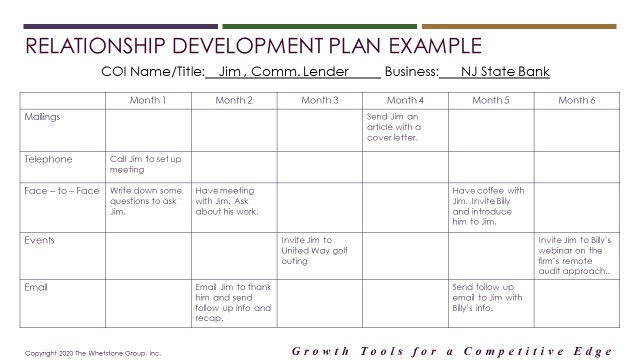
In many ways, your success rate is dependent on how well you stay connected to referral sources using tools such as mailings, telephone, face-to-face, events, and email. It’s helpful to schedule these items in a communication plan designed to nurture the opportunity. If you have a marketing professional in your firm, seek his/her advice on ways to do this leveraging firm resources. This is their area of expertise—so take advantage of it!
It’s often helpful to organize your activities into a calendar like this:
Continue to apply the “before-during-after” approach
This example uses the before, during and after planning approach for networking. However, your firm can (and should) apply this framework to any marketing and sales activity—whether it’s digital marketing, webinars or other events, getting published as a thought leader, direct marketing, or a host of other activities. A well-planned approach with proactive follow-up activities positions your firm for better execution and better ROI from your activities.
Finally, keep in mind that this approach is also not limited to market expansion activities. Client cross-selling is one example. Plan in detail which clients you will cross-sell to, their needs, and the services your firm can provide to meet those needs. Decide which questions you will ask and what you will communicate about your firm and its services during a meeting with your client. Be intentional about the follow-up steps you will take afterward to reach the goal of cross-selling to meet your existing clients’ needs.
A word to the wise
In our experience, the “after” phase is where marketing and sales activities tend to break down. Most CPAs don’t look past the “during.” Once they complete the activity they check it off the list and move on to the next item. The “after” is where the transition from positioning yourself and your firm to actually exploring ideas and offering to help prospects solve their issues happens (in effect, sales). And as you may have experienced, this process of sales usually happens over time. As you apply the before-during-after approach, make sure you pay careful attention to the after. Again, if you have a marketing or other business development professional in your firm, ask for their guidance.
A holistic approach to top-line growth that includes strategic thinking and well-planned and executed activities using the before, during, and after approach will enable you to reach your firm’s revenue goal.
Larry Bildstein is the CEO of The Whetstone Group, Inc., helping CPA firms and professional service firms nationwide find growth and hone their competitive edge.
Read the corresponding article: Best Practices in Revenue Growth, Part 1: Goal Setting and Strategy